A Blueprint for RINF Compliance
via "Baseline + Delta"
How a national railway infrastructure manager can bridge the gap between paper PDF standards and strict RINF Linked Data compliance.
The Challenge
For European railway infrastructure managers, the Register of Infrastructure (RINF) is a massive data engineering challenge. It requires submitting detailed parameters for every operational point and line section in a strict, complex Linked Data format.
The challenge facing many managers is a critical disconnection: authoritative data often exists in human-readable PDF documents (Infrastructure Standards and Network Statements), while the requirement is a validated, geolocated, and strictly schema-compliant Linked Data set for the full network.
"The objective: Convert static documents into a validated Linked Data set without losing data integrity."
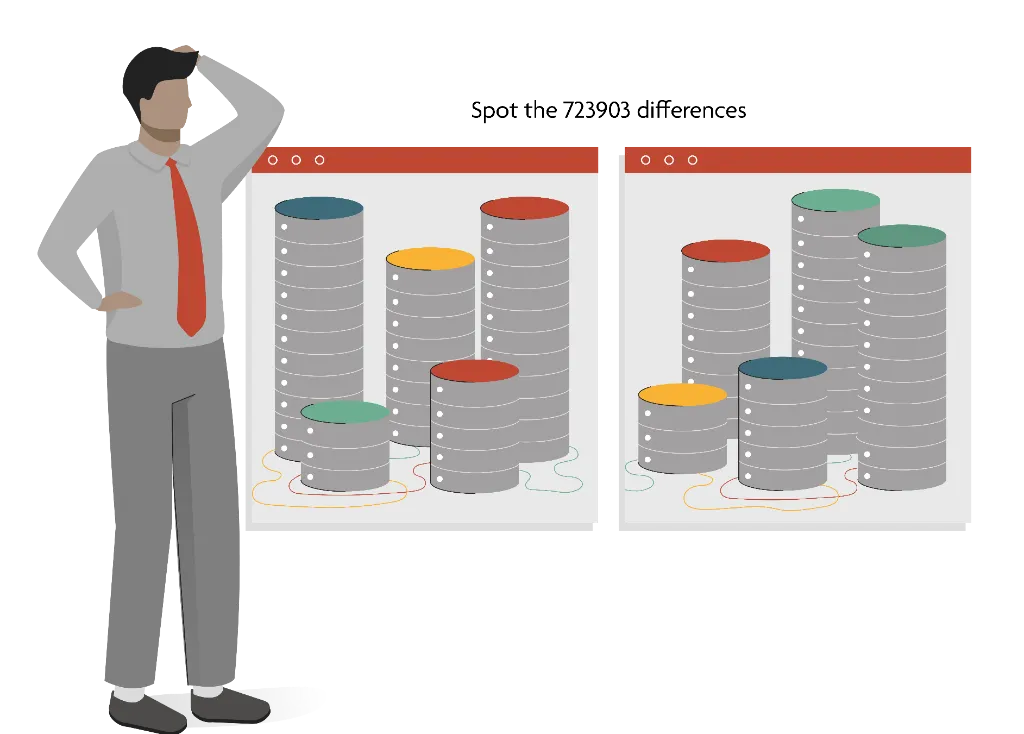
Spot the 723,903 differences between your legacy data and the reality.
The Strategy: A Hybrid Approach
Building a RINF Linked Data set from scratch every year is high-risk. We designed a "Baseline + Delta" strategy to prioritize data stability and provenance.
The "Baseline" Foundation
We treat the previous year's submission as a baseline, preserving stable high-quality data like Geographic Coordinates, Tunnel Structures, and TEN-T Classifications.
Selective "Delta" Updates
An automated pipeline extracts parameters from authoritative PDFs. This "Delta" layer only overwrites the baseline where new information is explicitly found.
The "Side-Load" Mechanism
A structured input for manual overrides allows specific corrections and gap-filling, ensuring expert knowledge isn't lost in automation.
Data Lineage
Every parameter in the final dataset carries a "source
tag" (e.g., Source: PDF IET50, Page 42 or Source: Baseline v28). This granular traceability allows validators to
instantly verify data against the original document.
Powered by Kapernikov Infra Data
Automation generates the file, but validation requires human insight. Our proposed architecture centers on a RINF Management Platform built on Kapernikov Infra Data.
GIS Visualization
Users visualize their network on an interactive map, and correct coordinates simply by dragging markers—replacing manual data editing.
Self-Service Validation
An automated dashboard flags compliance issues in real-time (e.g., "Passenger Stop missing platforms"), allowing fixes before submission.
Future-Proofing
The web app becomes the Single Source of Truth. The next submission starts from this validated state, not from scratch.
Facing a similar challenge?
Turn your regulatory obligations into a data management advantage.